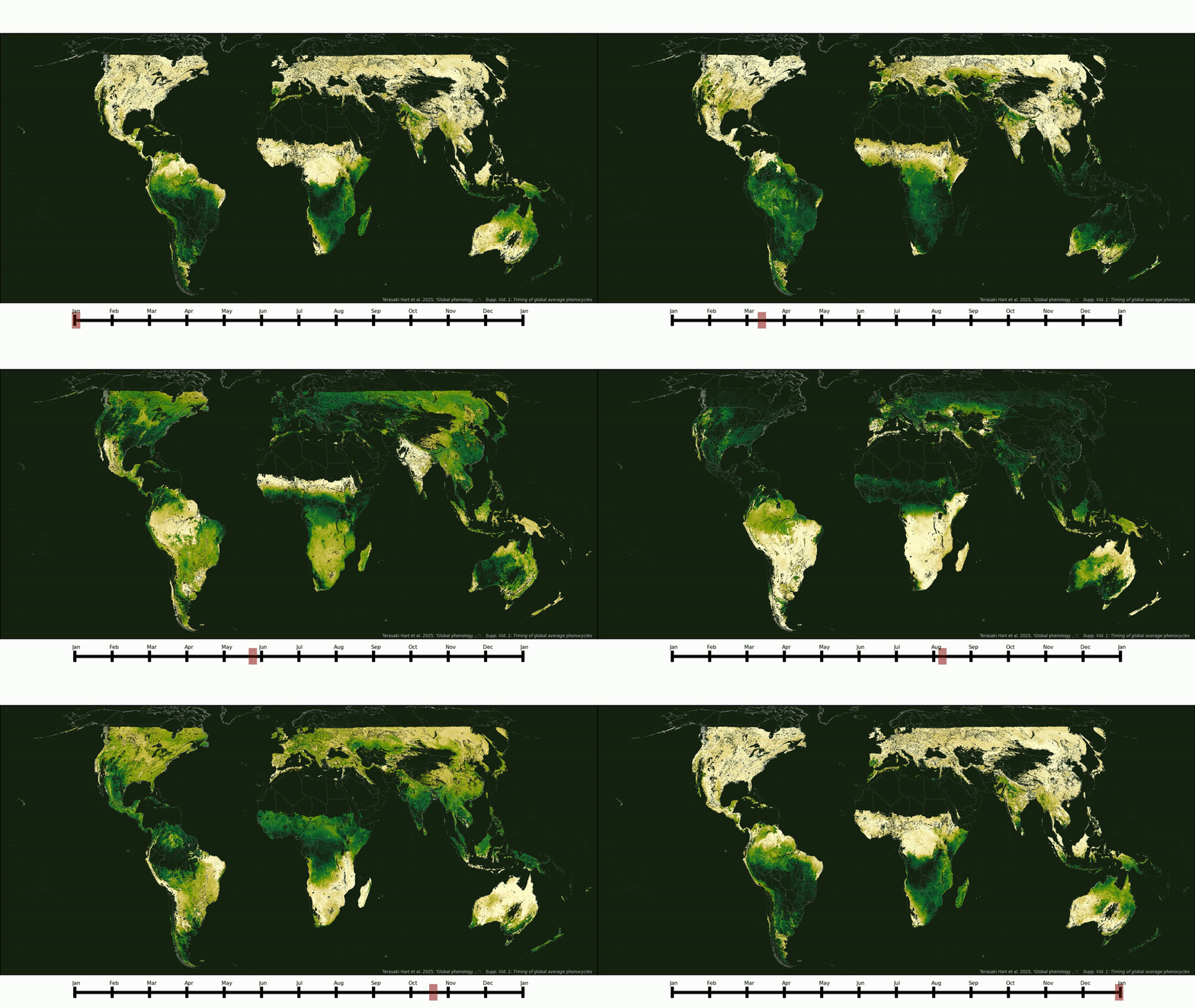
Average terrestrial ecosystem seasonality. Making each pixel cycle between its own minimum (tan) and maximum (dark green) emphasizes the complex geography of seasonal timing, irrespective of geographic differences in plant productivity.
Landscapes are complex, both in space and in time. In ecological science we often get away with swallowing temporal complexity into long-term averages and assumptions of ‘stationarity’ (that is, assumptions that the environment is static). But interesting and important dynamics sometimes hide behind these oversimplifications. I seek out these blind spots, to ask how complex space-time landscape patterns structure the ecological and evolutionary processes that generate, distribute, and maintain biodiversity.
Landscapes are changing at an unprecedented rate. From a long-time perspective, humans have exploded onto the scene, and we’re affecting everything. Change is the new normal. But ecological theory often assumes stationarity. Our field has a lot of work to do to understand if and how non-stationarity changes our beliefs about how nature works. This motivates a number of my basic and applied research projects. Advances we make in this space will improve our ability to manage and conserve nature on a changing planet.
I’m an interdisciplinary scientist. I have broad training: ecology, evolutionary biology, genetics, conservation, geography, statistics, computer science, environmental policy, agriculture, sustainable development. I try to read widely, think freely, and use creative problem-solving to chase big, imaginitive, and intriguing ideas, wherever they might lead me. I am motivated, in equal parts, by a passion for natural history, an predilection for abstract reasoning, a devotion to human-centered conservation, and a compulsion to share and to teach.
I’m a… sigh… data scientist. I have no aversion to fieldwork. (In fact, I quite love it!) But the sorts of questions I wonder about can often be addressed using data we already have at arm’s reach. A lot of data can be ‘found’ – e.g., public databases, remote sensing imagery, literature-locked measurements, et cetera. Some data can be ‘made’ – i.e., simulated. The biggest challenge of working these data is the complex suite of computational tools we use to wring meaning out of them. Thus (to my occasional chagrin) I am an environmental data scientist. Lucky for me, I love playing with computers. Unlucky for me, computers don’t like playing outside.
Acknowledgements:
This site is derived from the academicpages.github.io template.